Tag: Westfield

  • The “Iceberg” Wound: Understanding Deep Tissue Injuries 

    The “Iceberg” Wound: Understanding Deep Tissue Injuries 

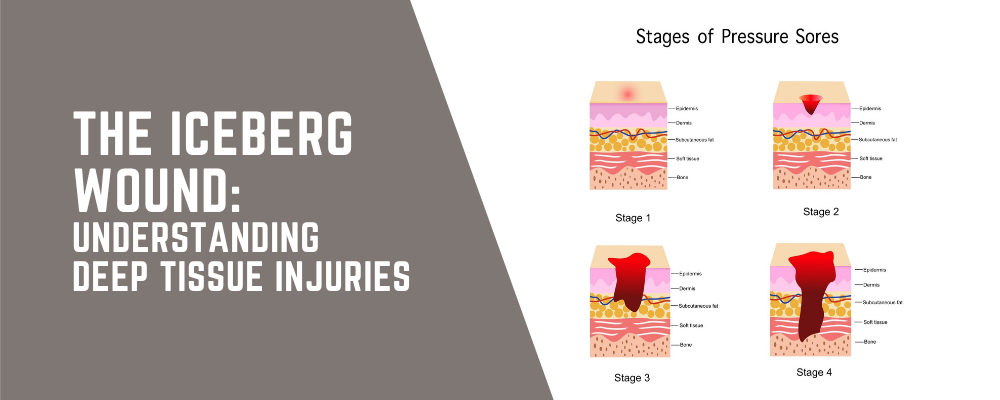
    When we think of a skin injury we usually think of something that happens from the outside in such as  a scrape, a cut, or a blister. As an in-home nurse practitioner specializing in wound care, I often see a much more deceptive type of wound: the Deep Tissue Injury (DTI). 

    Unlike a typical scrape, a DTI happens from the inside out. To help my patients and their families understand this I often use the “Iceberg Analogy.” Just as most of an iceberg’s mass is hidden beneath the ocean surface the most significant damage of a DTI is hidden beneath the skin’s surface.

    What Exactly is a Deep Tissue Injury?

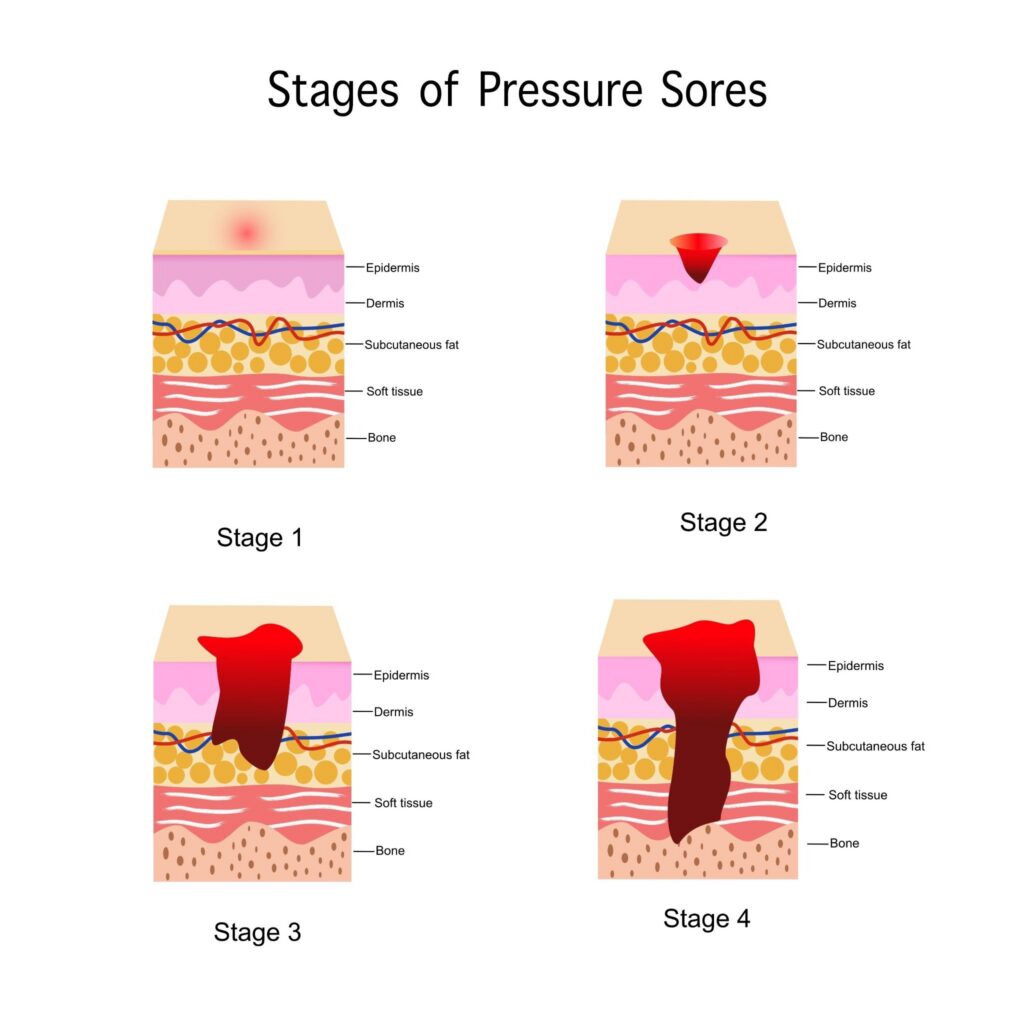
    A deep tissue injury is a unique type of pressure injury. It appears as a localized area of skin that is deep red, maroon, or purple. Sometimes it looks like a dark, blood-filled blister. 

    While the skin might still be intact, the tissue underneath (the muscle and fat layers) has been damaged by intense or prolonged pressure. Because muscle is more sensitive to a lack of oxygen than skin is, it actually begins to break down first. By the time you see that “bruise” on the surface, the damage underneath has already begun. 

    Identifying the Warning Signs

    Because DTIs can evolve quickly into more serious wounds, early detection is everything. If you are caring for a loved one at home keep an eye out for these three signs in areas where bone meets the bed. The more obvious places are the heels, hips or tail bones. Some other places that are often overlooked include the elbows, the back of the head, and the shoulder blades. 

    1. Color Changes: Look for persistent deep red, purple, or maroon discoloration that doesn’t “blanch” (turn white or return to normal skin color) when you press on it. See the last blog post for how pressure injuries look different on different skin tones.
    2. Texture Shifts: Feel the skin. Does it feel mushier, firmer, warmer, or cooler than the surrounding area?
    3. Pain: Patients often report a deep, aching soreness in the area before the color even changes.

    Why Do they Happen

    Pressure is the primary culprit, but it’s rarely acting alone. Usually it is a combination of:

    • Pressure: The weight of the body squeezing tissue against a hard surface like a mattress or a chair.
    • Shear:  The skin stays in place, but the bone and deep tissue slide, common when someone “slumps” down in a recliner.
    • Microclimate: Moisture and heat on the skin can make it more vulnerable to breakdown. 

    How We Manage DTIs at Home

    If I visit a patient and identify a DTI, our goal immediately shifts to “offloading.” We have to get the pressure off that spot completely. This might involve specialized foam dressings, “floating” the heels with pillows or utilizing high-tech pressure redistribution mattresses.

    It is important to note that DTIs are unpredictable. Sometimes with excellent care and nutrition the body can reabsorb the damaged tissue. Other times the dark area may eventually open up to reveal a deeper wound. This is why professional monitoring is so vital. 

    The Takeaway

    If you notice a “bruise” on a bedbound or chair bound loved one that looks darker than usual or feels different to the touch, don’t wait. Deep tissue injuries are a race against time. Early intervention is the best tool we have to protect the skin and promote healing from the inside out. 

    Contact Circle City Foot and Medical Care today at 317-269-7351 or visit circlecityfootandmedicalcare.com to schedule an appointment for your in-home foot care.

  • Beyond Redness: Identifying Pressure Injuries on All Skin Tones

    Beyond Redness: Identifying Pressure Injuries on All Skin Tones

    In the medical world, we are often taught that the first sign of a pressure injury is “non-blancable erythema”–a fancy way of saying a red spot that doesn’t turn white when you press on it.  But there is a significant flaw in that standard: it primarily describes how a wound looks on light skin.

    As an in-home Nurse Practitioner, I see patients of all backgrounds. If we only look for “redness,” we are going to miss early warning signs in patients with darker skin tones. When a wound is missed in its early stages, it has a much higher chance of progressing into a serious, deep seating injury.

    To provide the best care, we have to look beyond color.

    The Challenge of Pigmentation and Pressure Injuries

    In darker-pigmented skin, the “redness” phase may not appear at all. Instead, the skin may take on different hues, looking purple, bluish, or even slightly grayish. Because the changes can be subtle, the injury is often much more advanced by the time it is “visible” to the naked eye.

    This is why “skin of color” assessments require a more holistic approach. We aren’t just looking with our eyes; we are “looking” with our hands, and listening to the patient’s experience. 

    “Big Three” Signs to Indentify Pressure Injuries

    If you are caring for a loved one with a deeper skin tone, I recommend focusing on these three indicators rather than searching for a red spot:

    1. Temperature Changes: Before the skin breaks or changes color significantly, it will often feel different to the touch. Early on, an injured area might feel significantly warmer than the surrounding skin due to inflammation. As the injury progresses and blood flow is restricted, it might feel noticeably cooler
    2. Texture and Consistency: These are often the most reliable “early warning” signs. When you palpate (gently feel) the bony areas, like heels, sacrum, or hips, pay attention to the “give” of the tissue. 
      • Does it feel “boggy”  or mushy, like an overripe fruit?
      • Does it feel unusually firm or hard compacted to the surrounding skin?
      • Is there a “shiny” or taut appearance of the skin in that specific spot?
    3. The Patient’s Report of Pain: Never underestimate the patient’s “localized” pain. If a patient or loved one says a specific spot on their heel or tailbone feels “sore,” “burning,” or “throbbing,” treat it as a pressure injury until proven otherwise–even if the skin looks perfectly normal.

    Why Inclusive Assessment Matters

    Health disparities in wound care are a real concern. Statistics show that patients with darker skin tones are often diagnosed with pressure injuries at more advanced stages. This isn’t because their skin is “harder to care for,” but because the traditional tools for assessment weren’t designed with them in mind.

    By shifting our focus from color to consistency, temperature, and sensation, we can catch these injuries in Stage 1, where they are still reversible.

    Advice for Caregivers

    If you are monitoring a loved on at home:

    • Check in good lighting: Natural light or “cool” LED light is better than warm, yellow, indoor lighting for seeing subtle color shifts
    • Trust your touch: Your hands will often find a wound before your eyes will. 
    • Advocate: If a healthcare provider dismisses a spot because “it isn’t red,” don’t be afraid to point out changes in temperature, firmness, or the change from their normal skin tone! 
    • Color changes still happen! They just might look different than someone else’s. 

    Early detection is the best medicine. Whether skin is porcelain, olive, or deep ebony, the goal remains the same: keep the pressure off and the tissue healthy. 

    I’m currently accepting new patients in Marion and the surrounding donut counties. Contact Circle City Foot and Medical Care today at 317-269-7351 or visit circlecityfootandmedicalcare.com to schedule an appointment for your in-home foot care.

  • Why Your Back Pain Might Actually Be a Foot Problem

    Why Your Back Pain Might Actually Be a Foot Problem

    I often walk into a patient’s home and hear them describe a nagging ache in their lower back or a sharp pain in their hip. They are often surprised when the first thing I do is ask them to take off their shoes and socks. “It’s my back that hurts,” they tell me, “not my feet.” But what I see every day is that the body is a single, connected chain. When the bottom link–your feet–is out of alignment, every link about it has to compensate.

    The Kinetic Chain: From the Floor to Your Foot and Spine

    I like to explain the body using the concept of the “Kinetic Chain.” Your feet are the only part of your body that consistently touches the ground. They are designed to absorb the shock of every step and distribute your weight evenly. When I look at a patient’s feet, I am looking for the “foundation” of their movement.

    If you have a foot problem–wheter it is a painful bunion, a fallen arch, or even a thick, fungal toenail–you instinctively change the way you walk to avoid the pain. This is called antalgic gait. You might not even realize you are doing it. You may lean slightly to one side, shorten your stride, or stop rolling through your foot correctly. 

    The Ripple Effect of Gait Compensation

    When you change your gait to protect a sore foot, your muscles work in ways they weren’t designed for. If your arches collapse, your knees track inward, putting stress on the ligaments. This causes one hip to hike higher than the other, creating a tilt in your pelvis that pulls directly on the muscles of your lower back. I often find that a patient has spent months treating their back with heating pads, only to find the “root” of the issue is a corn or a callus that was forcing them to walk off-balance.

    My Role: Beyond the Trim

    One of the biggest advantages of seeing a Nurse Practitioner for your foot care is that I can look at the “big picture” of your musculoskeletal health. If I suspect that your foot alignment is causing significant issues, I have the authority to take the next clinical steps.

    • Diagnostic Imaging: If I am concerned about a structural deformity or a hidden fracture that is changing your gait, I can order X-rays or other imaging to get a clear look at what is happening under your skin.
    • Physical Therapy Referrals: Sometimes, the muscles in your legs and back have become so accustomed to “compensating” that they need professional retraining. I can write a referral for Physical therapy to help you regain your balance and strength.
    • Diabetic Shoes & Inserts: For my patients with diabetes, proper footwear is a medical necessity. I can perform the required exams and order specialized diabetic shoes and custom inserts that protect your feet while providing the support your back needs. 

    Finding the Right Foot Foundation

    When I am in your home, I also take a closer look at your closet. I look at the wear patterns on your soles to see if you are “over-pronating” (rolling in) or “supinating” (rolling out). If your shoes are worn out or unsupportive, your back will pay the price.

    I generally recommend looking for shoes with a firm heel counter (the back of the shoe shouldn’t collapse when you press on it) and a wide toe box to allow your foot to spread naturally. Brands like New Balance, Brooks, or Orthofeet often provide the structural integrity that aging feet require. 

    Finding Balance Again

    My goal is to get you moving smoothly again. When we take the pain out of your feet-whether through professional nail debridement or by ordering the right medical footwear–your gait returns to normal. Your pelvis levels out, and your back muscles can finally relax. If you are tired of chasing back pain, let’s start by looking at your foundation. 

    Your feet carry you through life—let’s make sure they’re up for the journey. I’m currently accepting new patients in Marion and the surrounding donut counties. Contact Circle City Foot and Medical Care today at 317-269-7351 or visit circlecityfootandmedicalcare.com to schedule an appointment for your in-home foot care.

  • The Truth About Toenail Fungus: It’s Not What You Think

    The Truth About Toenail Fungus: It’s Not What You Think

    I want to clear the air immediately: toenail fungus is NOT a hygiene problem. Having fungus under your nails does not mean you are “dirty.” In my practice, I see fungus in the cleanest of homes. It is an opportunistic infection which means it will grow wherever the opportunity exists. Fungi love dark, moist, and warm environments–which is exactly what the inside of a shoe provides.

    Why Is It So Hard to Treat?

    One of the most common questions I get is, “Why won’t this go away?” The reality is that toenail fungus is incredibly stubborn because it lives under and within the nail plate. Because toenails grow so slowly, the treatment is a marathon, not a sprint. Topical medications often struggle to penetrate the thick nail to reach the source. Oral medication is very hard on your kidney and liver and has many drug interactions. This is why I focus on professional management and containment. 

    Does it Affect the Rest of the Body?

    While it isn’t “dangerous” to your heart, lungs, or kidneys, it is a significant issue for the health of your feet. If left unmanaged, the fungus can lead to secondary bacterial infections, like cellulitis, especially if you have diabetes. This is the real reason I want to keep a close eye on it. 

    How Fungus Changes the Way You Move

    While the fungus itself won’t make you “sick,” the physical changes it causes to your nails can change your life. As the infection progresses, the nail becomes thickened and distorted. These thick nails press against the top of your shoe with every step. To avoid that pressure, you might begin to change your gait–walking on the side of your foot or shortening your stride. Over time, this leads to knee, hip, and lower back pain. In my in-home visits, my goal is to debride these thickened nails down to normal height, immediately reducing that pressure. 

    Your Daily Defense Strategy

    While I handle the clinical trimming, there is much we can do together to keep the fungus from winning. I ask my patients to focus on these daily habits: 

    • Dry Thoroughly: After your shower, take extra time to dry between every single toe. Fungus loves moisture; don’t give it a place to grow.
    • Fresh Socks Every Day: Avoid wearing the same pair two days in a row, if possible. And giving shoes 24 hours to “breathe” helps kill off lingering spores
    • Stay Consistent: Regular professional debridement keeps the fungus from “piling up” and causing pain or even wounds. 

    Moving Forward

    If you are struggling with the appearance of your nails, please know you are not alone. My role is to provide the clinical care that makes these nails manageable, so they don’t stand in the way of your mobility and independnece. I bring clinical foot and nail care directly to your door in the Indianapolis area. Click here www.circlecityfootandmedicalcare.com to schedule your in-home assessment, or call me at 317-269-7351 to see how I can help you stay mobile.

  • 5 Common Foot Care Myths That Could Be Hurting You

    5 Common Foot Care Myths That Could Be Hurting You

    In my daily practice as a nurse practitioner, I spend a lot of time “unlearning” old habits with my patients. Many of the most common foot care beliefs are outdated or even dangerous–especially for those of us navigating the changes that come with aging. Today, I want to pull back the curtain on a few myths I encounter most often when I visit patients in their homes.

    Myth 1: “It’s Just a Foot Corn; I Can Just Cut It Off Myself.”

    This is perhaps the most dangerous myth I see. I often walk into a home and find a patient using a razor blade, scissors, or even a pocketknife to “trim” a callus or corn. In the medical world, we call this “bathroom surgery,” and it is a leading cause of serious infections. 

    Because many of my patients have decreased circulation or neuropathy, they may not feel how deep they are cutting until it is too late. When I perform a debridement, I am using sterile instruments and clinical precision to ensure the skin remains intact and safe. If you have a growth that hurts, please leave the tools in the drawer and let a professional handle it. 

    Myth 2: “Medicated Foot Corn Pads Are a Safe Way to Treat Foot Pain.”

    It is very tempting to grab a box of medicated pads from the pharmacy aisle. However, these pads usually contain salicylic acid, which is designed to eat away at thick skin. The problem is that the acid doesn’t know the difference between a hard callus and the healthy, thin skin surrounding it. For a patient with diabetes or poor circulation, these pads can cause a chemical burn that quickly turns into a non-healing wound. I always recommend avoiding these “quick fixes” in favor of identifying why the pressure is happening in the first place. 

    Myth 3: “If I Can Move My Toe, It Isn’t Broken.”

    I hear this all the time after a patient stubs a toe on a piece of furniture. Unfortunately, the ability to move a digit is not a reliable test for a fracture. You can have a significant break and still “wiggle” the toe. Ignoring a fracture can lead to improper healing, chronic pain, and long term gait issues that increase your risk of falling. If there is bruising, significant swelling, or an odd shape to the toe, I want to see it. 

    Myth 4: “Soaking My Feet in Epsom Salts Every Day is Good for My Skin.”

    While a warm soak feels relaxing, doing it daily can actually do more harm than good for aging feet. Prolonged soaking can dry out the skin significantly, leading to small cracks (fissures) that allow bacteria to enter. For my patients with neuropathy, there is also a high risk of accidental burns if the water is too hot and they cannot feel it. Instead of soaking, a high-quality urea-based cream applied daily may be the better approach; just be sure to skip the area between your toes!

    Myth 5: “Foot Pain is Just a Normal Part of Getting Older.”

    This is the myth I find the hardest. Pain is not a requirement of aging! While your feet certainly change over the years, “normal” aging should not involve constant discomfort. Pain is your body’s way of signaling that something–be it your shoes, your circulation, or your gait–needs attention

    Why a Professional Eye Matters

    When I visit you for a foot and nail care appointment, my goal is to replace these myths with clinical reality. I am looking at the “big picture” of your health, from the shoes in your closet to the pulse in your ankles. By debunking these myths and focusing on evidence-based care, we keep your foundation strong and your mobility intact. 

    Don’t let foot discomfort change the way you live your life. As a Nurse Practitioner specializing in non-surgical podiatry, I am here to help you manage chronic conditions and prevent complications before they start. Contact Circle City Foot and Medical Care today at 317-269-7351 or visit circlecityfootandmedicalcare.com to schedule an appointment for your in-home foot care.